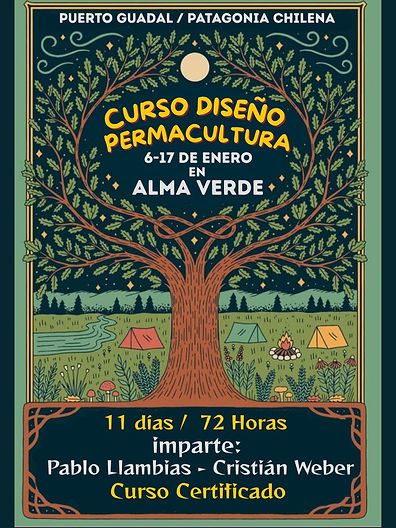
Permaculture Design Certified Course (PDC)
11 days Certified course in spanish
6-17 january
Learn permaculture immersed in an ecological regeneration project in Chilean Patagonia. Our PDC course combines theoretical training, practical fieldwork, and direct experience in agroforestry systems, water management, food production, and ecological design.
You will learn about:
-
Ethics and principles of permaculture
-
Regenerative systems design
-
Soils and natural fertility
-
Water retention landscapes
-
Agroforestry and food production
-
Appropriate renewable energies
-
Bioconstruction
-
Efficient stoves
-
Composting
-
Resilient economies
-
Design methodologies
-
Animal Handling
Why study at Alma Verde?
Because permaculture is best understood when it can be observed in practice.
Alma Verde is a permaculture school nestled in Chilean Patagonia, where permaculture principles are lived out daily through direct experience. Here, the landscape becomes the classroom, and every element of the place offers opportunities to learn about design, cooperation, and our relationship with nature.
During the course, you will participate in an immersive experience that combines learning, observation, community, and connection with the environment. It's a space to acquire practical tools, broaden your perspectives, and discover new ways of inhabiting and regenerating the land.
Format: In-person, 72 hours (10 days of classes)
Date: January 10-20
Value: 500,000


Learn permaculture immersed in an ecological regeneration project in Chilean Patagonia. Our PDC course combines theoretical training, practical fieldwork, and direct experience in agroforestry systems, water management, food production, and ecological design.
You will learn about:
Ethics and principles of permaculture
Regenerative systems design
Soils and natural fertility
Water retention landscapes
Agroforestry and food production
Appropriate renewable energies
Bioconstruction
Efficient stoves
Composting
Resilient economies
Design methodologies
Animal Handling
Why study at Alma Verde?
Because permaculture is best understood when it can be observed in practice.
Alma Verde is a permaculture school nestled in Chilean Patagonia, where permaculture principles are lived out daily through direct experience. Here, the landscape becomes the classroom, and every element of the place offers opportunities to learn about design, cooperation, and our relationship with nature.
During the course, you will participate in an immersive experience that combines learning, observation, community, and connection with the environment. It's a space to acquire practical tools, broaden your perspectives, and discover new ways of inhabiting and regenerating the land.
Format: In-person, 72 hours (10 days of classes)
Date: January 10-20
Value: 500,000
Profesores

Cristián Weber
Founder of Alma Verde Permaculture, with ten years of experience in permaculture. Bioconstruction specialist and water retention landscape designer.

Pablo Llambias
Creator of "Permaculture Podcast," the most listened-to permaculture podcast in Spanish, with twenty years of experience in bioconstruction, appropriate technologies, organic agriculture, and sustainable design.
El curso
Día 1 – Recepción y Bienvenida
-
Llegada e instalación.
-
Presentación de participantes y equipo facilitador.
-
Acuerdos de convivencia.
-
Actividades de integración.
-
Introducción general al curso.
Día 2 – Fundamentos de la Permacultura
-
Historia y evolución de la permacultura.
-
Mollison, Holmgreen, Fukuoka
-
Éticas de la permacultura.
-
Flor de la permacultura
-
Principios de diseño.
-
Concepto de sistemas.
-
Diseño consciente y regenerativo.
-
Ejercicios de observación.
Día 3 – Patrones, Procesos Naturales y Metodología de Diseño
-
Patrones en la naturaleza.
-
Patrones físicos y sociales.
-
Lectura del paisaje.
-
Escalas de permanencia.
-
Sectores y zonas.
-
Herramientas de análisis y diseño, topografía
Día 4 – Clima, Topografía y Agua
-
Factores climáticos.
-
Microclimas.
-
Orientación solar.
-
Vientos.
-
Ciclo hidrológico.
-
herramientas de topografia
-
Captación e infiltración de agua.
-
Introducción a swales y keyline.
Día 5 – Suelos y Fertilidad
-
Formación y estructura del suelo.
-
Biología del suelo.
-
Ciclos de nutrientes.
-
Compostaje.
-
Lombricultura.
-
Biofertilizantes.
-
Estrategias de regeneración.
Día 6 – Árboles, Bosques y Agroforestería
-
Funciones ecológicas de los árboles.
-
Gremios vegetales.
-
Bosques comestibles.
-
Sucesión ecológica.
-
Agroforestería.
-
Sintropia
-
Cortinas cortaviento.
Día 7 – Producción de Alimentos
-
Huertas agroecológicas.
-
sistema biointensivo
-
Policultivos.
-
Asociaciones de cultivos.
-
Manejo integrado de plagas.
-
Propagación vegetal.
-
Injertos
-
Semillas.
-
Calendarios y planificación productiva.
Día 8 – Animales en Sistemas Regenerativos
-
Funciones de los animales en el diseño.
-
Integración animal-vegetal.
-
Manejo de aves.
-
Apicultura
-
Pastoreo holistico .
-
Acuicultura y sistemas integrados.
-
Bienestar animal.
Día 9 – Hábitat Humano y Tecnologías Apropiadas
-
Diseño de viviendas. (Bioclimática)
-
Bioconstrucción.
-
Energía eficiente.
-
Estufas de inercia térmica.
-
Energías renovables.
-
Aguas grises.
-
Saneamiento ecológico.
-
baños secos
Día 10 – Diseño Social y Economía Regenerativa
-
Permacultura social.
-
Organización comunitaria.
-
Facilitación y toma de decisiones.
-
Economía local.
-
Emprendimientos regenerativos.
-
Gestión de proyecto
-
Transición comunitaria.
Día 11 – Diseño Integral y Presentación Final
-
Integración de contenidos.
-
Desarrollo de proyectos de diseño.
-
Elaboración de mapas y propuestas.
-
Presentaciones grupales.
-
Evaluación.
-
Retroalimentación.
-
Certificación y cierre.